
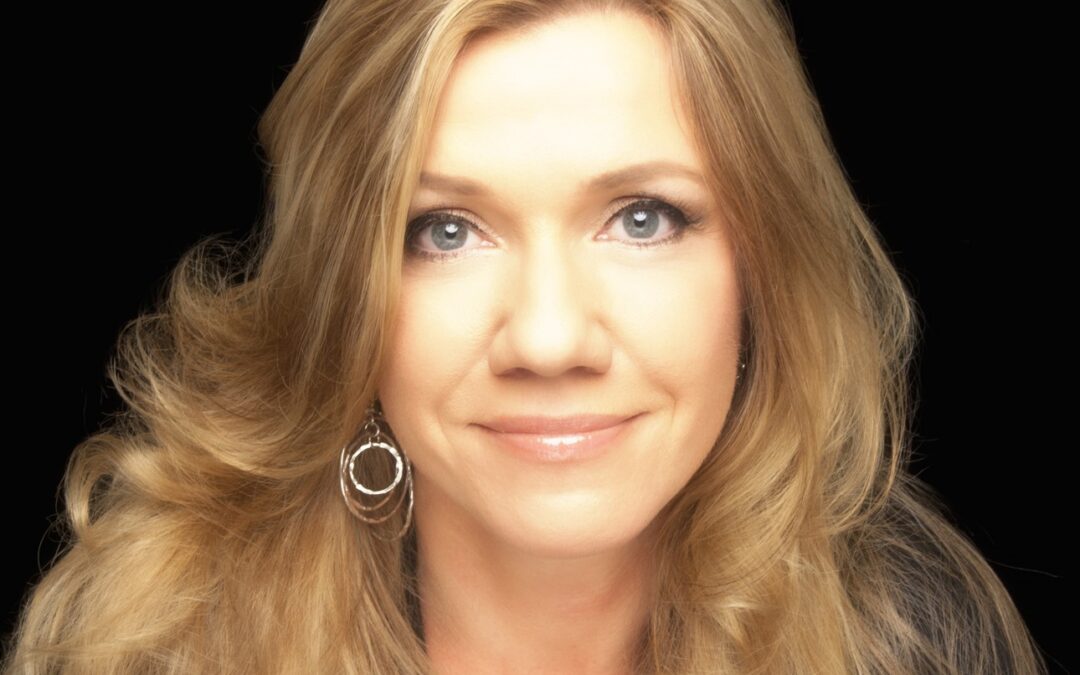
Meet Sonja Bruzauskas, internationally known mezzo soprano, music educator and founder of a Houston non-profit that brings students from different backgrounds together for healthy relationships through singing and other art forms.
We read a lot today about ways to try to reduce stress in our multi-tasking, highly distracting world where the internet can detach us from close personal interactions. Is today’s environment also detaching us from our inner selves? Can music and singing be a therapeutic outlet? Most of us have the sense that music makes us feel good and is stimulating. Taking it one step further, can singing to ourselves casually or in a choir help us release or express our emotions, and help us connect with others?
Indeed it can, according to Ms. Bruzauskas. We sat down to talk about what Sonja described as the unique and powerful emotional benefits of singing, both alone and with others (Sonja says you don’t have to be a professional vocalist to reap benefits). Through her many years of experience in the music world and as a voice instructor, Sonja is able to share her insights on exactly how singing can affect us internally to improve emotional well-being and strengthen social ties.
Sonja believes that now more than ever, with the internet as well as neighborhoods distancing us from our deeper selves and from people, we are in need of healthy emotional outlets that are easily accessible. She says singing provides this opportunity. Below is our interview with Sonja:
Why is singing beneficial?
Empty Nest Network: Why do you think singing is emotionally therapeutic, and what do you think is behind it?
Sonja: As a voice instructor, I’ve witnessed firsthand the profound emotional impact of singing. Many years ago, as a young voice instructor, I guided a woman in her vocal exercises, when she suddenly became overwhelmed with emotion and began to cry. A few lessons later, it happened again. Then I saw the same response in another student. Not long after, a male student began laughing uncontrollably while vocalizing. Embarrassed, he apologized, saying, “I’m sorry. I’m not a silly person, and I don’t know why this is happening to me!” Eventually, I placed a box of tissues on my piano and began asking myself: Why were these emotional responses emerging during singing lessons? The more I reflected, the more I realized how little we use the full range of our voices in everyday life. Most conversation occurs in the lower part of our vocal range, rarely venturing into the higher pitches we possess.
These days, we speak even less than we did decades ago. We text instead of call, email instead of meet, and order food or groceries online for curbside pickup with little or no verbal interaction. As a result, we are often disconnected from one of our most powerful forms of human expression. It is entirely possible to go through much of the day barely using our voice at all. Singing, however, invites us to access our full vocal range—and in doing so, it can unlock emotions that have long remained unexpressed. What I initially found surprising has become one of the greatest lessons of my teaching career: when people find their vocal abilities and range, they often find feelings they didn’t know were waiting to be felt.
Digging deeper
ENN: And you as a professional singer have opportunities to express yourself often. How would you say the use of our full vocal range unlocks our emotions, specifically?
Sonja: Well, professional singers are of course a rather rare kind, but I asked myself, when would someone with little or no singing history use the full range of their voices? The answer is, when someone has very big emotions. When someone is laughing or crying – and this is true for everyone – when you are yelling or crying about something upsetting or simply yelling at other drivers on the road, or having an argument with someone. When you are out with a friend sharing a funny story and laughing a lot. This is when you are using other pitches and higher frequences of your voice. You are letting deeper emotions out.
The next question I asked myself was, why do we like to sing in the shower, for example? Why does it feel good to most of us? Or together with others at church, or at other big life events? At funerals and at weddings? How did that come about? Why do we want to sing the national anthem together with others at a sports event? There are benefits of singing together with others that I’ll explain later, but singing in general, even privately, will help you access and utilize the higher frequencies in your voice. And this is emotionally beneficial.
ENN: How do you think our minds respond when we sing?
Sonja: I believe that when we sing, the brain may draw an association with a memory of an authentic emotional experience simply because we are using similar frequencies: a moment when we were deeply moved, whether through laughter, tears, anger or other powerful feelings. As soon as we begin to vocalize and feel (remember) the emotion behind the sound, our bodies can respond in ways we do not always consciously understand (such as inexplicably crying or laughing). I do believe this happens because we subconsciously associate the higher frequencies and physical sensations of our voices with past emotional experiences. Singing becomes a way to connect with our emotional selves.
Did our earliest ancestors have it right?
ENN: Tapping into emotions through the different pitches of our voice is a fascinating thought. Where do you believe it originally comes from?
Sonja: Let’s go back to our earliest ancestors who had no spoken language. Anthropologists, scientists and philosophers have speculated about the origins of language with varying opinions and theories. But one thing everyone seems to agree about is that early humans used their full voices to communicate and express themselves.
ENN: Crude as it would have been.
Sonja: Yes. As language developed, humans lost the need to utilize the upper ranges of their voices over time. The only reason we still have access to those ranges is that human babies do not have language, but they do need to communicate, and they do it by using their FULL voices.
ENN: The different frequencies and sounds a baby uses indicate their feelings.
Sonja: Correct. Babies, both in the past and today, cannot speak, so they must first learn to communicate before they develop spoken language. Parents “read” these sounds to understand whether a baby is hungry, in pain, tired, or happy. Through these vocal expressions, parents learn to recognize what their child needs or wants. This is the baby’s language, and that form of communication still exists today. When we consider the earliest humans (before the development of spoken language) it is likely that they relied on the full range of their voices to express emotions, needs, and experiences. Their voices became a bridge between their inner world and the outside world. In this sense, there appears to have been a collective connection emerging from within each individual and extending outward into the community.
ENN: And music? How do you think that emerged?
Sonja: Everyone had and has a heartbeat, and a voice box. There was likely an early sense of rhythm derived from the heartbeat, and drumming also became a form of communication. So here you have a heartbeat and a voice – rhythm and song, dance and music. To answer your question, music and also dance are simply cultivated versions of human expression. Culture.
ENN: We need to bring back create more opportunities for that kind of expression.
Sonja: Most definitely.
A prescription for everyday singing
ENN: Do you have a prescription, so to speak, for singing to more fully access pent-up emotions in modern times?
Sonja: There are many different ways to approach music. As a professional singer, I approach music as an art form, using the voice as a cultivated instrument for artistic expression, and opera represents one of the highest forms of refinement of the human voice—a remarkable achievement of culture and discipline. But the voice belongs to all of us. Beyond artistic expression, it is a natural vehicle that connects us to our emotional selves as we talked about. That is why I encourage everyone to sing freely and without judgment. Never underestimate what vocalizing can do for your well-being. Sing or hum in your car, or in the shower, or anywhere you feel comfortable. Whether it is high art like opera, popular music, a simple traditional melody, or just random sounds, the emotional benefits of using your voice can be profound. Take time each day to make vocal sounds, sing along with the music you love, and enjoy the simple act of letting your voice be heard. Do karaoke. Sing for yourself.
ENN: What if we feel self-conscious about it?
Sonja: You WILL feel self-conscious or vulnerable because you rarely use these registers, and when you do, you are often feeling big emotions. It is ok!
ENN: We should go into higher notes even if we think we can’t reach them or sound good?
Sonja: Absolutely. Again, we distinguish between high art and everyday singing. There is no competition in everyday singing. Allow yourself to sing in your full range, and do not judge yourself. Never feel that you do not have the right to sing simply because someone else may be a “better” singer. That is not the purpose of everyday singing. If you are alone doing chores, one of the greatest sources of joy can be turning up your favorite music and singing along. Sing more often than you may have before – loudly, freely, and happily. Sing something that moves you so deeply it brings you to tears.
The special joy of singing together with others
ENN: Tell us now about singing with others, including in choir. People say it feels uniquely good to sing with others and they perceive a special connection with them.
Sonja: That has more to do with physics, I would think. When we sing at a certain frequency, our bodies respond like a guitar or another string instrument. Our vocal folds begin to vibrate at that frequency, and because they are connected to the rest of our body, those vibrations travel through us, causing our entire body to resonate at that frequency. These vibrations then move into the air around us, causing the surrounding molecules to oscillate at the same frequency. When another person is around, they are receiving those sound waves, and their own bodies respond to the vibrations. In this sense, when we sing together, we are all participating in the same physical process — creating a shared field of vibration where everyone becomes connected, through sound.
ENN: Can this explain why people who sing in a choir or together at public events feel a certain bond and emotionally moved?
Sonja. Very much so. And while this is pure physics, depending upon the individual, the choir experience might actually feel very spiritual for some people.
Choose your instrument
ENN: You’ve talked about using our voices for emotional release. What about playing a musical instrument?
Sonja: Well, the voice is the original instrument, and every other instrument was modeled after it. I do believe that, as a secondary benefit, learning to play an instrument can help a person connect with their emotional self. Perhaps it is not as direct as producing sound through our own bodies, but the same principle of vibration still applies. When we play an instrument, like the piano or the guitar, the strings and mechanisms create frequencies that travel through the air. The surrounding air molecules begin to vibrate at those frequencies, allowing us to experience sound not only intellectually, but physically and emotionally as well.
Bringing children and communities together through song
ENN: Tell us about the non-profit group you founded called, Partnershools. I believe you have told me the organization has touched 20,000 students in Houston and other parts of Texas from private, charter and public schools, who through singing and other art forms learn about each other and build relationships.
Sonja: Partnerschools’ mission is to form friendships through art education and creative expression. We do what our name implies – we partner schools together in our communities. This allows students and faculty from both schools to foster a stronger and more peaceful community. Imagine two school choirs from vastly different neighborhoods meeting monthly, having a joint concert at the end of the school year, all with plenty of social time, food and snacks and games. We use the arts to build connections, and our work is never about artistic excellence (which you can see is part of the same theme as what your article is about). Our vision is genuine connection and understanding between all communities and cultures. Learn more at www.partnerschools.org

ENN: I know that your two children are now grown, so was it an empty nest inspiration for you when you had the idea for Partnerschools?
Sonja: I certainly thought about my gifts and talents, and how to properly utilize them to make a difference in this world. The original idea of connecting communities through the arts goes back to 2012 when my own children were small, and I facilitated a choir partnership between their school choir and a choir in a different neighborhood. It became clear that we could have a lot of impact by growing the project. In 2018 we became a non-profit organization, and now we serve over 60 schools annually with a strong team, and my now empty-nest-self happily serving as CEO.
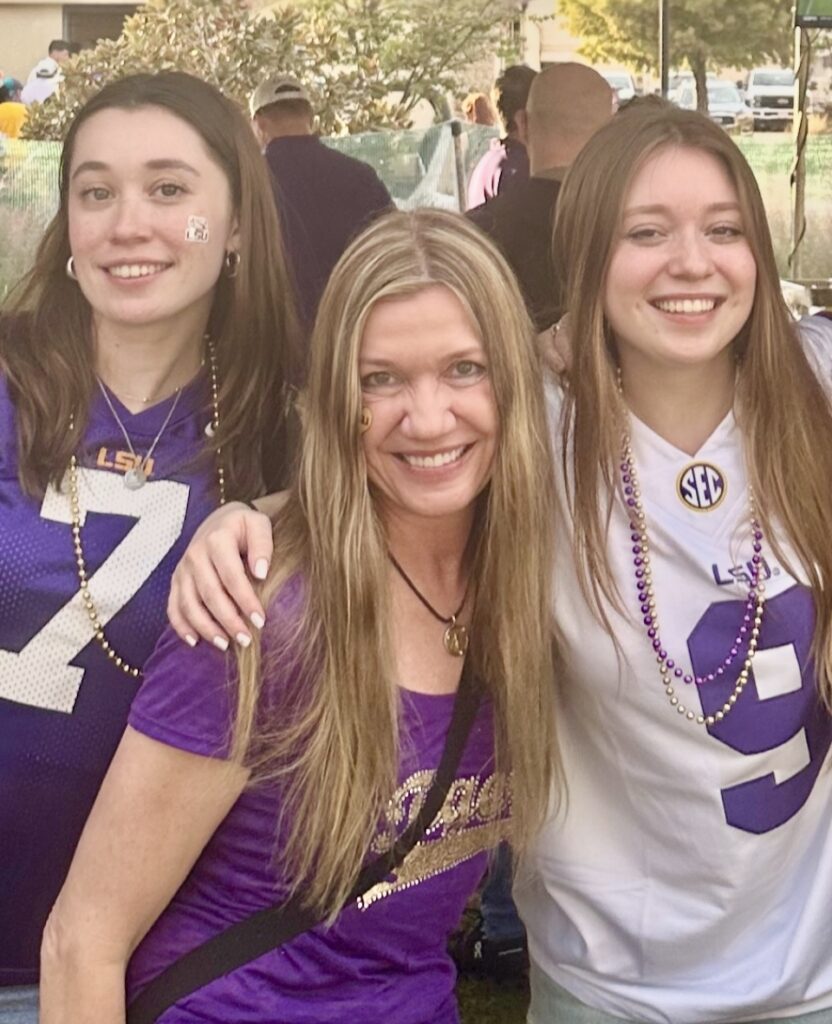
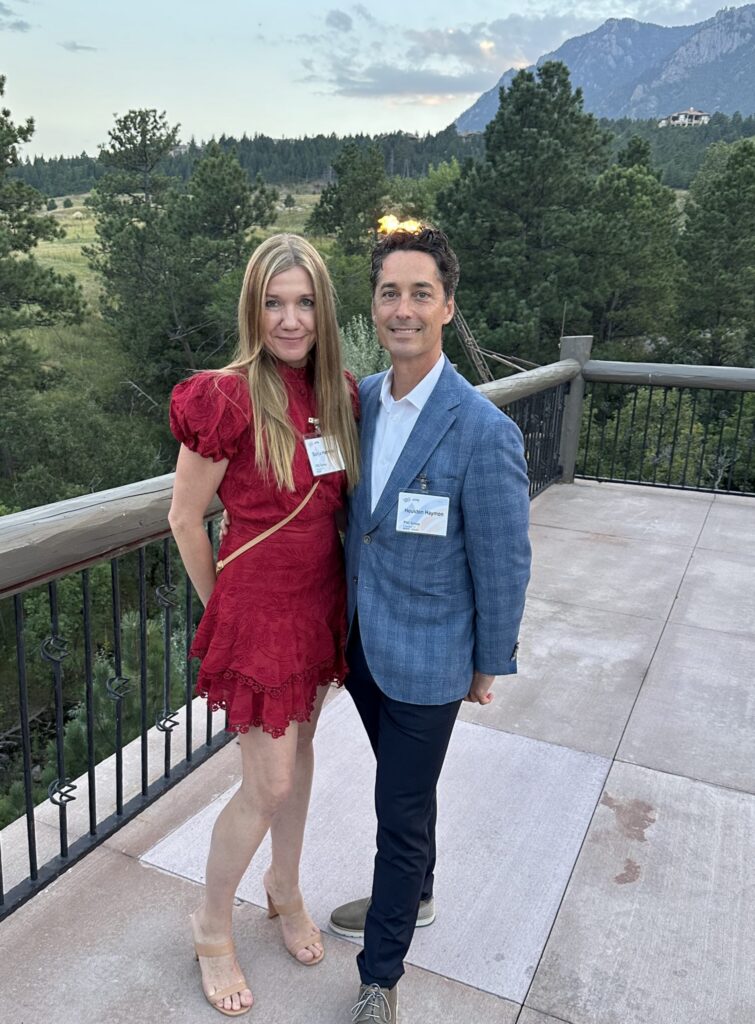
Sonja with her daughters, Emilia Haymon and Clara Haymon, and husband Houston Haymon
ENN: Sonja, it is very evident that at this phase of your career and as an empty nester you are expanding upon your considerable music expertise and using your energies to make a positive difference in the world. On behalf of Empty Nest Network, it has been a pleasure interviewing you about the emotional benefits that can be derived through something as easily accessible as our singing voice.
(Photos in this article provided by Sonja Bruzauskas)

Sonja Bruzauskas – Mezzo Soprano/ Arts Educator/ Non-profit leader
Born and raised in Germany, Sonja Bruzauskas was trained on both sides of the Atlantic Ocean. Besides her expansive stage career in musical theater, opera and operetta, Sonja is a well-established concert singer and recitalist, focusing on German Art Song and contemporary music.
Engagements include the Staatsoperette Dresden, the Santa Fe Opera, Volkstheater Rostock, Nordharzer Staedtebundtheater, Babelsberger Filmorchester, Bochumer Symphoniker, Baton Rouge Symphony Orchestra, Da Camera, Ars Lyrica Houston, Bach Society, Mercury the Orchestra Redefined, the Greenbriar Consortium, the Houston Chamber Orchestra, the Houston Chamber Choir, ROCO and The Roundtop Institute. Sonja has sung and lectured at institutions such at Vanderbilt, LSU, Rice University, the University of Houston, the Philosophical Society of Houston, California Summer School of the Arts, Grinnell College, Blue Mountain Chamber Music Festival, Round Top Festival Institute, CalArts, as well as numerous health institutions.
Board of Director positions include the Houston Chamber Choir, the Houston Tuesday Musical Club, the German Center Houston; Board Chair positions: Philosophical Society at Rice University, Ars Lyrica Houston, Partnerschools Inc.
Sonja serves as Producer/Artistic Director for the Theatre Forum at Round Top and is the founder and CEO of Partnerschools, a non-profit organization that creates friendships through arts education and creative expression.

To our readers: If you have positive experiences you’ve gained through music and singing that you think could provide inspiration to others and would like to offer comments in the section below you are welcome to do so.
Consult with your healthcare provider and other appropriate professionals before
engaging in any of the activities or following any advice in this article. Empty Nest Network is not
recommending the use of any promotions, products, services or sources that may be referenced in this interview and you do so at your own risk. The views and opinions expressed in this interview and any related conversations on this website reflect the views and opinions of the interviewee only and not that of Empty Nest Network.
I’ve been singing my entire life, school choirs, nursing school choir, church choirs and now in 2 community choirs.
I’m 78 years old and I was diagnosed with asthma after she 40.
Singing helps with my asthma because of the deep breathing that I’m constantly doing while singing.
More importantly, I can’t explain the feeling when the choral group has completed a performance.
It’s such a “high” that I feel this feeling of accomplishment and satisfaction, maybe it’s a dopamine release or rush, I feel like I’m floating.
Having never experienced with drugs in my 51 year medical career, I’m wondering if this is what people feel when they do “uppers” or cocaine?
Singing is my happy place, it’s my social platform for singing about humanity and the need to be kind and respectful to others.
Singing is music to my soul.
I’m grateful God gave me a voice to make music with others. It’s my passion and enjoyment place, I wish everyone could experience what I’ve felt and hope to continue to feel while 🎵 .🎶 singing.
How wonderful, Bobbie. Keep singing and spread the word! I sometimes wish world leaders could open summit meetings by singing a song together….
Best, Sonja